This is Ruth's blog, since that was very not readily apparent from the title. Unless I told you. If I didn't tell you, get away from here stalker.
Sunday, March 10, 2013
Whose Line Is It Anyway was a comedy improv show from the nineties, and also two-thousands that was hilarious and amazing and oh so wonderful. And it's coming back!!!!!!
So first some history and a basic introduction for those poor unfortunate souls who haven't heard of Whose Line. It was and will be an improv comedy show. Improv is a form of theater where basically you're given a prompt and then you have to make everything else up. For example, in Whose Line, there's a thing called Scenes From A Hat where audience members write down things like people who you wouldn't expect to be president, and then the four improv actors come up and say things like hitler or whatever. So there's four improv performer people in each show, and then there's Drew Carey as the host and he gives them queues and stuff. And mostly everyone is just really funny. That's all.
Ok so this week Colin Mochrie, who was one of the performers, tweeted and he was like HEY GUYS WHOSE LINE IS COMING BACK and so everyone was like WHAAAAT. And then it was confirmed, and there's going to be a new host, some lady named Aisha Tyler, and it's going to be coming back this summer which is really exciting and I am very excited. Well that's it basically, so here's a video of the episode when they had Robin Williams on (all the episodes are on youtube by the way)
Sunday, February 24, 2013
My mom and I went to go see an exhibit of Ai Weiwei's art this Saturday. It closes today so you all missed it. Which is too bad because it as a really good exhibit. And Ai Weiwei is a really good artist. It was at the Hirschhorn which is also a really cool museum. So all around it was really cool.
Basically Ai Weiwei does a lot of protest art against the Chinese government, so he gets put under house arrest a lot which means he has even more time to make art I guess. A lot of his art involves taking an object that is pretty meaningful, and giving it a new meaning. Like he has this one piece called Straight, where he took metal rebar pieces from collapsed schools from the 2008 earthquake and then turned them into this sort of map of a division symbolizing both the earthquake, and also the division in society. It's pretty cool looking.
A lot of his art, at least in this exhibit, was influenced by the 2008 Sichuan earthquake. It killed a lot of people, many of them children. This was because many of the schools had been really badly constructed so they just fell down pretty much. And other buildings nearby hadn't just fallen down like that, so that pointed to cutting corners and really bad construction where that shouldn't have happened. And then the one-child policy meant that a lot of families lost their only child. So basically it was a really big, terrible horrific thing. Something like 5,000 children died due to the terrible schools. One of Ai Weiwei's most moving pieces, for me at least is this one giant snake that he made. At first you're like oh wow that's pretty cool it's a giant snake. But then you see that's it's made out of backpacks, one for each child who died in the earthquake. And it's a really big snake, too.
Well those were some of the newer Ai Weiwei art pieces. Of course there was the one where he drops the ancient Ming vase, and all the other Ming vase desecration pieces (they're really cool). If this art sounds interesting to you, I would recommend the documentary "Ai Weiwei: Never Sorry". It's on Netflix instant.
Friday, February 8, 2013
http://www.youtube.com/watch?v=mdNZ5vXWMxQ
I have to give you the link because that's the only way I can get it into the video. Sorryyy.
This week the British kids are here, and they're leaving on Sunday, but it was really fun. I had one stay at my house, her name is Emily, and we're totally best friends now. So for film class, we did this project where instead of continuing on with our boring documentaries, we worked on these new fun projects. Everyone got into groups, and then each group got assigned a prop. Our prop was this postal service box filled with tubes and beakers and some weird clocks and also some fairy wands.
So then we had to brainstorm ideas. Most of our ideas revolved around aliens or spaceships or something like that, but seeing as it would be really complicated to actually film a 60 short set in a spaceship and make it look believable, we decided that instead we would go with a mad scientist who makes an android, then falls in love with the android, but the android doesn't know what love is, so the scientist teaches the android how to love with computer coding and a montage, and so the android finally learns to love but once it does it dumps the scientist for some other guy. And then we had to write our script.
We decided that our film was going to be silent because that's just so much easier. So we wrote out a basic script that was pretty much all just description of what was going on, then we did our shot list, and then we did our storyboard and it all turned out beautifully. So then the next day, we borrowed a room from the science teachers, and I got a lab coat (it was so much fun to wear), and then we set about filming. We had to come in after school to film the rest of our movie because it took us a while to figure out how to work out Katie's mom's complicated camera, but once we did, everything was fine.
So we had all our film, and then we set about to editing. We decided to use color correction, so that as the android learns to love the colors slowly turn from colder colors to warmer colors. I'm really glad we thought of that, because that made our short look so much nicer. We also had this thing where after the robot leaves the scientist, it goes to black-and-white. That also looked really cool.
Everything turned out really nicely, and I'm really glad we got a chance to do it. It was a nice break from the documentaries, and it was also just really fun. So after this we go back to documentaries, and then from there on to CAP Hollywood which I am quite excited about. Second semester in general sounds really fun. We could make really amazing films for CAP Hollywood if we put the effort into it, and that's exciting to me.
Anyway, hope you liked the short, and I hope I wrote about everything I was supposed to write about in this post.
Sunday, January 27, 2013
For me, downtown Silver Spring is really kind of boring. It's mostly just the movie theater, some restaurants, and a couple of stores. Really it's just a place to go with your friends, but you'd rather be somewhere else because there's nothing to do. Although maybe I don't know the right places or something. Anyway, I live really close to a metro station, and so for me, Washington, D.C. is a lot more interesting than Silver Spring. There's soooo much more to do in D.C., and in general it's just way more interesting. I go to D.C. more often, and it's a lot easier to go to D.C. without other people than it is to go to Silver Spring by yourself. And my friends don't always like going places. Sooo this weekend I went to the National Gallery of Art, and took a lot of video of art, but my camera died before I got the impressionist section or the only Da Vinci in the U.S. or all the weird Renaissance art. So it goes. But I still had a fun time, and there was an unfinished Michelangelo statue, the David-Apollo which is so named because it is either David or Apollo. That was really awesome, but again, dead camera so you don't get to see it unless you use Google.
(I think the video might be private but YouTube won't let me sign in so I can't do anything about it sorryy)
The paintings and two sculptures featured in this video are, in order of appearance:
The Return of Rip Van Winkle by John Quidor
Mrs. Richard Brinsley Sheridan by Thomas Gainsborough
Shaw Memorial by Augustus Saint-Gaudens
Lake Lucerne by Albert Bierstadt
The Abduction of Europa by Jean François De Troy Señora Sabasa Garcia by Franciso de Goya
The Washington Family by Edward Savage A Young Man in a Large Hat by Frans Hals
Captain Patrick Miller by Sir Henry Raeburn The Mill by Rembrandt Van Rijn
Miss Beatrix Lister by Sir Joshua Reynolds
The Skater (Portrait of William Grant) by Gilbert Stuart
Sir Joshua Reynolds by Gilbert Stuart
The Voyage of Life by Thomas Cole The Emperor Napoleon in His Study at the Tuileries by Jacques-Louis David
Keelmen Heaving in Coals by Moonlight by Joseph Mallord William Turner David In The Lion's Den by Sir Peter Paul Rubens
Young Girl Reading by Jean Honoré Fragonard Voltaire by Jean-Antoine Houdon The Fall of Phaeton by Sir Peter Paul Rubens Madame Moitessier by Jean-Auguste-Dominique Ingres
Sunday, January 6, 2013
Yaaaay it's a new year, we get to write 2013 on our papers now. Alright, well, it was also Christmas too, and so this post is kind of Christmas-y I guess. See, my neighbors across the street have this fantastic lights and inflatable Christmas display, and they also play the best music! It's so wonderful (that was all sarcasm)! But their displays bring up some questions. See, I mentioned that they have Christmas inflatables (they have inflatables for every season). And they're also really into hunting. Sooo.....
I know it's really blurry, but that right there is a snowman with a gun. Also Santa in what I am told is a deer blind. Santa also has a gun, and he's joined in his cheery deer blind by a penguin, and there's a deer down below who looks really terrified (it has bugged out eyed. Santa's seems pretty happy though, and the snowman is smiling). It used to be just the snowman, but they got the deer blind Santa this year. Whenever anyone drives by their house, they slow down and stare because why wouldn't you (some neighborhood gossip: apparently the guy once had a dead deer hanging up in his back yard and it was dripping blooood, because I guess that's what you do to dead deer)?
Anyway, (that was an introduction) I thought I would write about this because it's a freedom of speech issue. Where I live, it's pretty liberal, and these Christmas inflatables seem offensive to us. I mean, Santa Claus is going hunting. And yet we're granted the freedom of speech in the Constitution, and we've come to interpret that as everything but hate speech. But then what's hate speech? Usually, in the law at least, it's defined as any form of words that incite violence or prejudicial actions. So in that context, deer blind Santa doesn't seem like hate speech. Maybe if he were actually killing the deer, and there were blood and guts and stuff. But deer blind Santa is kind of sweet looking and cartoony, and so is the shooting snowman (who isn't actually shooting that's just what we call him). So it seems kind of weird and offensive to my liberal sensibilities, but it's really not that bad.
Of course, I had planned to write this before Sandy Hook happened. After that having happened, it seems a lot worse. The neighbors have had them up since long before the shooting, and haven't taken them down yet. I still don't think it qualifies as hate speech, since it wasn't in retaliation to the shootings, and it doesn't really have anything to do with the shooting beside the guns. Seeing as I had basically written everything before the shootings, but this post deals with guns, I wanted to make sure I addressed if anything changed after the Sandy Hook shootings.
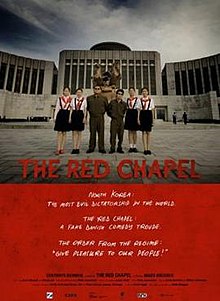
Recently I watched the documentary "The Red Chapel", made in 2009. It's about three Danish guys who pose as a theater troupe called The Red Chapel troupe, and go to North Korea under the pretense of cultural exchange. Actually though, they're spying. The name Red Chapel is a communist reference, but to a communist group spying on Nazi Germany, so maybe not the idea that the North Koreans had. The group is made up of the journalist Mads Brügger, and the comedians Simon Jul and Jacob Nossell. Simon and Jacob were born in Korea, but given up for adoption and grew up in Denmark. This was the first time they'd been home. Here's the trailer, kind of long, but good.
Mags is a weird sort of journalist. He impersonates things he's not in order to get information he wants, and that's what's going on here. He gets these two comedians to pretend they're a communist sympathizing theater troupe, so he can get in and try and expose North Korea and get good solid evidence of the atrocities the government commits. The troupe does actually put together a show, with skits and tap dancing and songs, to perform. But tt turns out a little differently than he expects. Besides focusing on Mags' search for truth, the documentary also looks at Jacob's experience. See, Jacob suffers from cerebral palsy, so he's usually in a wheelchair, has speech issues, and his muscles don't work the way they're supposed to. His intelligence level is normal, but everything else is really obvious. North Korea has been accused of killing children with disabilities. As they get closer to the performance date, the North Korea government representatives assigned to the troupe give Jacob a smaller and smaller role, eventually saying that he can't even talk. Jacob says that when he went there he was naive and didn't realize how bad it really was, he was only 18, but it really did serve as an awakening for him, as well as to highlight the issue of how people with handicaps are treated in North Korea.
Something that I really like about this documentary is that there's a counterpoint to Mags' view that North Korea is terrible, and he is right in doing whatever it takes to get the information out. Mags says that he has no scruples at all, and he joins in in doing whatever the North Koreans are doing so they won't get suspicious, but Jacob won't do it. He believes that the issue is more complicated than Mags will admit too, and they have some interesting discussions about it. But Mags also talks about whether he prompted Jacob into an emotional breakdown, and whether he's right for doing this without being confronted which I liked. It was nice that he entertained the thought, and talked about it in the movie. While a lot of it is dedicated to him trying to catch the North Koreans, and he can be a bit of a jerk sometimes, he's honest and I thought that was good.
This documentary is really interesting because it shows what it's like inside of North Korea. At least as much as is possible, given that the government really doesn't allow anyone outside of a given area. But they are shown a lot of Pyongyang, schools, culture centers, and they go on some picnics. Mads compares going on a picnic in North Korea to going on a picnic in the Black Forest in Nazi Germany. While watching the movie, you're always reminded of the terrible conditions, the totalitarian government. Pyongyang is empty, there's almost no one in the streets. And the three Dutch guys have this lady named Mrs. Pak follow them around everywhere, all the time, and they're only allowed to see what the government wants them to see. They have a camera, but they have to turn over the film to government censors, who will cut out any parts they see as demeaning to their "Great Leader", Kim Jong Il (remember this was made in 2009).
"The Red Chapel" was made with not that great of a camera, and it was just one camera, so they can't really get all that fancy with the cinematography. But the editing is really nice, especially in this one scene where they all go to school. There's a bunch of super talented genius kids, and pictures of Kim Il Sung and Kim Jong Il everywhere, and it's all edited so that is goes by very quickly, with the Great Leaders in pretty much all of the shots, and it's really overwhelming which is how it was for the Jacob and Simon. There's also a recurring motif. Trusted members of the inner party get these little pins with a picture of Kim Il Sung's face on them, and whenever they meet someone new there's a shot of the pin. This isn't really editing, but it's kind of in the same category. They used a lot of archival footage of old performances, or old appearances of Kim Il Sung and Kim Jong Il, and that really added to the image of North Korea that they were creating.The sound is similarly sort of elegantly understated, basically just whatever they had available. They got to watch some performances by some of the super talented genius children from the school, and sound from those performances is used in throughout the movie. Other than that, it's mostly just dialogue, ambiant noise, and also Mags' narration that was added in after they came back to Denmark.
I thought this movie was really interesting, and it might not be interesting to everyone, but I think if you're interested in current events or world history or stuff like that then it would be interesting. Also it's just entertaining to watch and see the interactions between the government officials and the three Dutch guys who are trying to see how far they can push it. After these three guys, no Dutch journalists have ever been let in to North Korea. Here's the movie poster, here is a link to the movie's website, and this is the end.
Sunday, December 9, 2012
Today I went to the National Museum of Women in the Arts, because they had an exhibit called Women Who Rock about women in music, and it was really cool and so I thought I would write about it. They started in the 1920s ish and then into now except they went from now back to the 1920s so it wasn't in chronological order which was kind of annoying. But they had the costumes, and lps, and lyrics, and they had Joan Jett's guitar, they had a bunch of people's guitars and several bass too. So that was really cool, especially getting to see the handwritten lyrics. They had tv screens playing biographies for all the artists featured, and then they also had a room where they played music videos.
The exhibit was broken down into several different time periods, and I'm now going to write about one person from each time period (briefly) and then link a video. Because that little paragraph was short, and everyone in the exhibit was really good. So to start off our journey through female music making or whatever, let's look at Maaaaa Rainey. It's actually just Ma Rainey. She was one of the earliest, and a very influential blues artist, known for her powerful voice, energy, and her peculiar "moaning" style of singing. She made songs that poor people in the South could relate to, like "Bo Weevil Blues" and that made her really popular also she was really cool so that helped. Here is one of her songs. Quality isn't that great, because at the time Paramount had terrible audio recording equipment so sad. It's called Booze And Blues.
It's really bluesy, and wonderful, and you can kind of hear her excellent voice. Alright so now we move on to the thirties. Sister Rosetta Tharpe was not only an excellent guitar player, she was also willing to cross the line between spiritual and secular, and bring gospel to us atheists. Fun fact: a video of her playing is also featured in the movie Amelie (the first e should have an accent but I don't really feel like figuring out how to do that). Anyway, so Rosetta was really influential on people like Elvis on Johnny Cash, and she was really good, so here's some of her playing. It's called Up Above My Head.
Ok now to be honest I can't really remember the forties very well, so I think what we'll do now is just sort of skip over to Ruth, yes Ruth Brown. So Ruth Brown was an R&B artist, who made R&B more commercially successful. Ok so now we're going to start getting into the part where not only are the female artists influential and good, they write songs about women's issues. So Ruth Brown popularized R&B, and Atlantic (record company) was known as "the house that Ruth built" because she was so successful and everyone loved her. She also wrote a song about being in an abusive relationship, and the song ended with her saying that she was going to leave. This is technically not the regular version, but I like it better. It's called Mama; He Treats Your Daughter Mean.
So then there was the sixties. Doo-woppy girl groups, or single acts, was how women interacted with music. There were actually just a lot of them, and they usually had really cool names. So for the early sixties (by the end it had changed a looot so the museum divided it into two halves when organizing, and i am following in their footsteps) we're going to look at Leslie Gore. Besides having a good name, she wrote one of the first feminist anthem songs. She also decided to go to college, instead of continuing on with her 15 minutes of fame kind of career. So while she may not have really influenced music a whole lot, she was an important figure for women. Here is You Don't Own Me.
The second half of the sixties were pretty different from the first half. Psychedelic rock, folk, hippies, all kinds of weird stuff. Janis Joplin is a favorite of mine, and also a very influential person, so she is our focus person (that sounds right) for the late sixties. She had a fantastic voice, and sang with so much passion, and was incredible, and her lyrics had all of that too. It's so raw, and she sang about things without boundaries really. She sang about love REAL LOVE MAN I feel kind of silly saying that, I'm all of sixteen years old, but you can hear it in her voice it's real for her. So I have to link Piece Of My Heart what kind of person would I be if I didn't.
And so now it's the seventies, in time travel women's music land. My personal tastes are going to greatly interfere here, since they gave pop artists like Cher and then rock musicians like Joan Jett I'm going to go for Joan here always. So this paragraph is about Joan Jett. She founded one of the first all-girl rock bands, and it was even mildly successful in Japan yeah! Then she started Joan Jett and the Blackhearts, and wrote awesome songs, and was an awesome guitarist, inspired at least in part the riot-grrrl movement, and she still plays today. Way to go Joan. I'm gonna go with Bad Reputation here even though it had bad words aahhh
And now we're onto the eighties almost done guys they kind of lumped the nineties in the with the eighties and the two thousands I guess everyone would just like to forget them, right? Haha well moving onto Kim Deal, and punk! Kim Deal was the bassist for The Pixies, and then she went on to form her own band, The Breeders, where everyone except for the drummer is a girl. She's a great bassist and guitarist, and she achieved success with both The Pixies and The Breeders. Both bands were really popular in the 90s, and the punk movement. This is Cannonball, one of The Breeders' most successful songs.
And so now we're in the present! Mostly the museum people chose to focus on pop music artists, which makes sense, since they're the ones who have been the most visible, and it's sort of our generations music much as it pains me to say that. But ok so they had three separate display cases for Lady Gaga which really bugged me, because Lady Gaga is really just a pale imitation of Madonna and there are tons of other people in that exhibit they could have given two extra cases too. One of them was her meat dress too. Ugh anyway, back on track, this paragraph is about Bikini Kill, from the riot-grrrl movement which was pretty much all feminism and Bikini Kill was one of the biggest bands out there. The last couple of songs haven't been really explicitly about feminism, but pretty much all of Bikini Kill's are. So this is the last song, and it's not exactly a calming finish but whatever. The video is cool too. Here is Rebel Girl.
So in conclusion, it was a really cool exhibit. I knew a lot about the later musicians, but not a lot about the early ones. There were a lot that I didn't mention, but they were all very interesting. Like other women in the 19th century, they had to fight to make their voices heard, and we can still hear them today how poetic was that. But they made good music, about important issues, and it was a good exhibit. If you can go see it before January 6th at the National Museum of Women in the Arts, you should because it's pretty interesting. The end.